



by Barb Quaintance
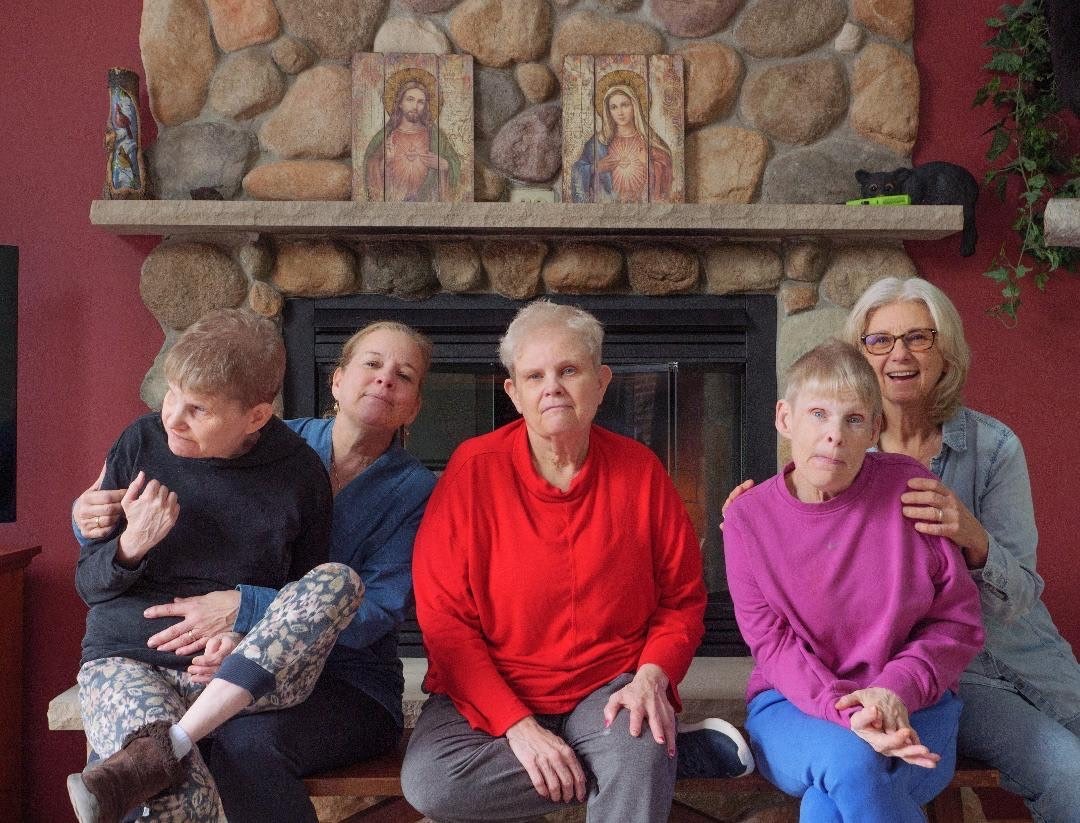
On the South Side of Chicago, Leonard and Helen Wolniak ran a funeral home that had been in the family since 1922. They also raised five daughters, Nancy, Laura, Janet, Christina, and Karen. Born in the 1950s and ‘60s, three of the girls—Laura, Christina, and Karen—had a rare genetic condition, PKU, that wasn’t properly diagnosed or adequately treated until many years later. Today, babies are routinely tested for PKU, and with a specialized diet, they develop normally. Nancy and Janet were always very involved in their lives and became legal guardians after the death of their parents.
Laura, Christina (lovingly called Tinka), and Karen have cognitive disabilities as well as varying degrees of physical impairment. When their parents could no longer care for their three daughters at home, the parents moved their daughters into a CILA group home through St. Colette’s of Illinois in Mokena; they lived there for 25 years. They attended a sheltered workshop in Tinley Park. The family was well aware of Misericordia, as Janet Wolniak Bender worked at Misericordia South for twenty-five years, starting as a music therapist and eventually becoming Director of Misericordia South. Nancy Wolniak Cook, who had a degree in special education, helped with the family business and became a licensed director/embalmer. Nancy was also familiar with Misericordia, as Wolniak Funeral Home provided some funeral services for Misericordia residents.
by Barb Quaintance
During the Aging With Grace webinars, staff from a variety of disciplines—Speech, OT, PT, Behavior, Nutrition, etc., shared what they look for as residents age. It raised the question: Is anyone taking a holistic look at the residents’ functional changes? It’s Misericordia, so, of course, the answer was Yes.
Chris Hegg Krackenberger, VP of Residential Services, explained that residents are routinely assessed at “functional change” meetings. These are interdisciplinary meetings when staff take a look at behavioral, physical, or functional changes that they observe in a resident. Some residential areas, such as McAuley and Marian Center, hold these meetings monthly. Other residential areas do them on a quarterly or as-needed basis. For example, if a Qualified Intellectual Disabilities Professional (Q) notices that a resident is not functioning as they have in the past or is exhibiting new behaviors, the Q will request a meeting to gather input from behavioral and physical therapies, DT/CDS, etc. The group shares what they see to determine a plan of action. This may include medical follow-up as well as strategies to help the resident cope and adapt to the changes they’re experiencing.

by Linda Buchalo
Are you looking for a way to give back? Are you interested in having some fun? Do you want to support one of Chicago’s most treasured organizations? Become a Misericordia volunteer! You can make a difference by choosing from many different opportunities. When you volunteer at Misericordia, expect to make new friends, have a good time, and feel rewarded.
Let’s talk about how to get started and cover some of the many volunteer opportunities that are available.
The easiest way to jump into a volunteer role is to attend an orientation for new volunteers. At that meeting, staff try to match someone’s current interests and availability with current volunteer needs.

by Barb Quaintance
We all know the basics of Candy Days: volunteers in the community raising awareness and funds for Misericordia, Giving Pages, candy packets, etc., etc. But here are some additional fun facts and stories from 2026 Candy Days that might be new to you!

by Barb Quaintance
“It’s a story of love.” That’s how Emad Garibovic describes his family’s experience with Misericordia. And such a beautiful story it is.
Emad came to the United States from Bosnia. Shortly thereafter, he moved to Rogers Park, just a few blocks from Misericordia. He often came to campus to think and reflect—and he took walks there with his daughters, Dzenana and Hana. Emad believes many things led him to Misericordia. His neighbor, Marge Murphy, was a longtime Misericordia employee and encouraged him to apply for a job there. A few years later, Emad began working at Misericordia and, 23 years later, is the Director of Housekeeping & Laundry.
Emad and his wife, Senita, welcomed their second daughter, Hana, twenty-seven years ago. At eighteen months old, Hana was diagnosed with cerebral palsy and developmental delays. Emad and Senita did everything they could to care for Hana and meet all her needs. That included Hana attending the Northside Learning Center and, for many years, the day program at Misericordia. Meanwhile, their other daughter, Dzenana (Sivac), became a Mis employee, working at the Village and McAuley.

by Barb Quaintance
We all vividly remember the day our family member became a Misericordia resident, even if that was many years ago. It was likely marked by some combination of joy, excitement, sadness, and trepidation. The following weeks were also emotional: helping our child navigate this huge transition, learning about all the staff involved in our child’s care, and understanding the expectations of being a member of the Misericordia community. We looked to the staff to give us all the “facts”, but we might have felt like we needed a sherpa to help navigate this new and sometimes overwhelming situation. That’s where the Misericordia Family Association (MFA) comes in.
The MFA is the membership organization for parents/guardians of residents at Misericordia; in fact, families automatically become members when their family member is admitted to Misericordia. It’s the MFA's goal to welcome new families—parents and siblings—and to provide support over the years.
by Barb Quaintance
It’s not easy to start a new job. Even with good orientation and training, it’s very different once you are in the job. There’s a need to become competent in the necessary skills. There’s learning the culture of an organization. There’s understanding what to do when things don’t go according to plan. That’s where the Misericordia Lead Job Coaches (LJC) come in: they partner with new staff in their residential area to support them throughout their first year on the job.
Who are the Lead Job Coaches—and how do you become an LJC? A Direct Support Professional (DSP) who is recognized by their supervisor for their excellence and confidence in their job is referred to Human Resources. The DSP then applies when the LJC position is posted in their area. The area ultimately decides if they will be selected for their new role. When a DSP is chosen, they attend a two-day HR training session where they learn to use their leadership skills to support new hires. They also work with HR throughout the year to hone their skills. Typically, a new hire will shadow an LJC for two weeks, observing how they perform specific tasks and interact with residents. The LJC is available to the new staff for their entire first year at Misericordia.

by Linda Buchalo
Every day, we see Misericordia staff in action as they care for and work with our family members. It’s awe-inspiring to see how smoothly the process runs, given that many of the residents need a lot of supervision and may have difficulty following directions. Yet, day after day, life goes relatively smoothly for over 600 residents, both on and off campus. We can thank the amazing planning capabilities of Misericordia administrators and staff for this minor miracle.
What happens when an unexpected event causes a glitch in the daily routine? Think about situations that you have experienced in your own life—medical emergencies, severe weather conditions, hazardous spills that require evacuation, and so on. Imagine having to deal with situations like these for 600+ residents and 1600+ staff.

by Barb Quaintance and Julie O'Sullivan
Most Misericordia families have a favorite Misericordia event: the MFA Benefit, Family Fest, Candy Days, and the Women’s Ball. My favorite is the Artist in All. It’s a spectacular event, and the residents are the stars of the show.
I wanted to learn more about the history of the Artist in All (AIA) and what it takes to pull off this memorable evening, so I talked to Julie O’Sullivan, Director of Events and Public Relations for the Misericordia Foundation. Julie is instrumental in making AIA the success it is, and she has a lot to share.

by Barb Quaintance
Siblings have lifelong relationships that can bring great joy. But there are also challenges in any relationship, including relationships with our special family members. The Misericordia SIBS organization celebrates those sibling relationships. Its members are actively engaged in the lives of their brothers and sisters and in the broader Misericordia community.
The SIBS organization has four core elements:
Page 1 of 12